Wednesday, April 29, 2009

WESTERBORK SERENADE at EZRA BESSAROTH in Seattle


WESTERBORK SERENADE
JUNE 28TH
at EZRA BESSAROTH in Seattle


When: Sunday, June 28, 2009, 8:00 p.m.
Where: Congregation Ezra Bessaroth, 5217 S. Brandon Street, Seattle
Cost: $22.00 each (or $30 each at the door), Check, Credit Card or Cash
Tickets: Call Susan Jensen @ Congregation Ezra Bessaroth office, 206-722-5500, for reservations and payment. Deadline for all reservations is June 24, 2009
No host bar and appetizers prior to the performance: 6:30 – 8:00 p.m.
Proudly presented by the Adult Programming Committee
Congregation Ezra Bessaroth

Monday, December 29, 2008

WESTERBORK SERENADE WINS 2008 "FOOTLIGHT AWARD"

"The Westerbork Serenade" gets a 2008 Footlight Award from the Seattle Times for
Swell Solo Shows!
Hit title to check it out!

Saturday, November 22, 2008

Chaja Goldstein: Westerbork Performer, Yiddish Mime,The Original Beatnik

Chaja Goldstein performing as Yeshiva boy in 1933 ->


"Chaja" by Paul Citroen


June and Paul Lowenberg contacted me last week because they recently found out that June's late aunt, Chaja Goldstein had been in Westerbork.
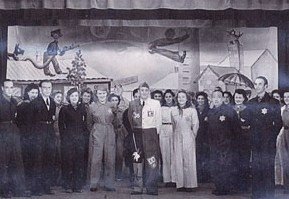
Goldstein is listed in the program for the first official Westerbork revue: Bunter Abend/Colorful Evening (July 1943)

http://www.max-ehrlich.org/bunter.htm

Goldstein was an all around performance artist who specialized in Yiddish songs and dances that were familiar to her childhood in Poland. One of her signature pieces was dressing as a Yeshiva boy to perform her numbers. In 1998 I interviewed Louis Dewijze,an other survivor who was in the Westerbork revues. He remembers Chaja as being famous to Jews throughout Europe for her Yiddish ditties.

Goldstein is also mentioned in some Westerbork accounts: Year of Fear by Phillip Mechanicus and Letters from Westerbork by Etty Hillesum. Both accounts recall Chaja performing in the revues and being invited to the Commandant's place for drinks with other celebs such as Camilla Spira.

She was not religious. June Lowenberg says that to her Orthodox family, Chaja's choice to become a dancer was initially met with shock and dismay.

"She was the original Beatnik" says Paul Lowenberg.

Chaja, who survived the war, spent most of her early life in Berlin. She moved to Holland and appeared in one of the first exile cabarets there, Cabaret Ping Pong, in 1933. According to Berlin Cabaret by Peter Jelavich, Ping Pong was closed down by the Dutch authorities for being too political so Chaja moved to Switzerland with other prominent Ping Pong performers like: Julia Marcus, Dora Gerson and Kurt Egon Wolff. They returned to Amsterdam the following year with a less political show that also included Dutch performers.

Chaja Performed around the world in the 30's. She was friends with and posed several times for the master portraitist, Paul Citroen as well as for Marc Chagall. June Lowenberg recalls that she was dancing in Bali and received a telegram not to return to Holland because the Nazis were going to invade. But assurances from her husband to the contrary convinced her to go back.
Chaja returned to Holland and eventually went into hiding.

"She got claustrophobic in hiding with all the people" says June, "And she went out."

Goldstein ended up in Westerbork where it is believed she stayed for the rest of the war.
Chaja's Husband, Theo Gusten, was a non-Jew and prominent German film maker.
Probably Goldstein's mixed marriage along with her celebrity status allowed her to survive. However it was required that she be sterilized.
Gusten also survived the war, but he was placed in several prisons by the Gestapo because he produced anti Nazi films. Gusten wrote a short account of his horrific experiences which the Lowenbergs are just starting to have translated. It tells of harrowing acts of defiance such as sharing news with other Inmates (punishable by death) and humming the "International."

After the war Chaja and her husband eventually moved to New York where they ran the International Graphics Art Society for many years. Eventually,they retired to Amsterdam.
Finally Chaja went to Israel to be near a surviving relative. But her yearly visits to her niece were very special.
June remembers that Chaja "exposed me to so much culture. We would go to museums and concerts. Once they went to see Marcel Marceau. Chaja was sometimes known as the Yiddish Mime.
"Every move she made, every gesture was always so theatrical."

June says that Chaja never talked about here experiences during the war. And she never performed again.

"Three weeks ago we didn't know any of this." says June.

Wednesday, November 12, 2008

Contact from Granddaughter of Westerbork Singer


Sarah Gabriella Waisvisz is a directing student in the fine arts program at the University of Ottawa. She is also the granddaughter of the widow of Max Kannewaser aka. Jones (right in picture) of the Dutch singing duo Johnny and Jones.
Johnny and Jones were in some revues at Lager Westerbork and they are characters in The Westerbork Serenade.

"Of course he never knew me" says Waisviz."
Kannewaser's wife Suzanne (nee Koster) survived the war. They did not have children together. After the war Suzanne married Sarah's grandfather, her childhood friend, Gabriel Waisvisz, and helped raise Gabriel's son, Sarah's father Jacques Waisvisz.

"My family's history has always been one of my major preoccupations," says Waisvisz. "Especially for my writing and for the theatre I make.

Sarah is currently directing selections from Waiting for Godot and she decided to contextualize the scenes so that Vladimir and Estragon are Yiddish actors fleeing persecution in WWII. She found www.westerborkserenade.com while researching Johnny and Jones music to use in her scenes.

Sarah laments that her grandmother was not more open about her time in captivity.

"But she has completely blocked it. Once she immigrated to San Francisco she and my grandfather (who had been in hiding) claimed that they were Christian and not Jewish, etc etc. After Westerbork she was sent to Auschwitz and she suffered terribly there. Just how much she suffered was never explained, but I know of a few atrocities. Everything is more or less a secret, other than a few things that have slipped out here and there."

Her grandmother lived through Auschwitz, came back to Holland, looked up old friends to see who was still alive, found my grandfather, and stayed.

"That is what we know," says Sarah.

"She has held onto things that belonged to her first husband, and she has original records of their music, I think, and I think she probably loved him very much...that was her youth and her first love and it was all taken away...it is tragic. Now she doesn't talk about anything at all, and doesn't want to. History is a funny thing.
And also, the world is so small."

for more info on Johnny and Jones: http://westerborkserenade.com/history/

Thursday, July 10, 2008

Westerbork Site Tells Fate of Relative


Gunther Witepski (Seen top with Camilla Spira in a sketch: "V and the OD", left in the next picture from the sketch: "In Der schule") was listed as a writer and performer in the Westerbork Revue programs from "Humor Und Melodie" (September 1943) and "Bravo Da Capo" (October 1943). Gunther's Nephew Michael contacted me from Johannesburg after having seen Gunther's picture on the history page of our web site. Michael's father, Wilhelm Witepski fled to South Africa in the 1930's and never knew his brother's fate. Gunther does not appear in any shows after "Bravo Da capo" and probably left on a transport in November 1943. Gunther died in Auschwitz in March of 1944. For more info see: http://www.max-ehrlich.org/performances.htm

Monday, March 24, 2008

Sketches and songs in "The Westerbork Serenade"

SKETCHES AND SONGS IN "THE WESTERBORK SERENADE"

Die Westerbork Serenade, Johnny and Jones (1944), translated by Meiti Opie, adapted by David Natale,

Man without a Passport (Mench ohne Pass), Max Werner Lenz (1935), translated by Laurence Senelick

Oyfn Pripetshik (At The Fireplace), by Mark M. Warshawsky (1901),
“A flame burns in the fireplace, and the room warms up, as the teacher drills the children in the alef-beyz: Remember dear children, what you are learning here. Repeat it again and again: komets-alef is pronounced o.”

Magdeline, by Willy Rosen ('42 or '43), translated by Louis Dewijze and Annatina Luck, adapted by Natale

Wenn Ein Paketchen Kommt, by Willy Rosen (1943), translated by
Louis Dewijze and Jerry Silverman,

Rozhinkes Mit Mandlen (Raisins and Almonds), by Abraham Goldfaden (1880), “Under Yidele’s cradle is a snow white kid, the kid is destined for market, that will be your fate too, selling raisins and almonds…”

Die Dammenschue Von Zimmer No. 20, (The Lady’s Shoes from Chamber No.20) by Herbert and Rudolf Nelson (1939), translated by Luck, adapted by Natale,

“The Snag,” from “Sek,” by Conrad Tom (1931), translated by Senelick, adapted by Natale,

Das Bist Du, by Willy Rosen (1944), translated by Dewijze, adapted by Natale,

OOO-Oh Boom! Johnny and Jones (1938)

Ich Liebe Nur Die Heide (I love only the Heath), by Willy Rosen (1943)
“I love only the heath. Alone on the heath I can be happy.
Yes that is my wish. My soul rises as the sun laughs.”

Hatikva (The Hope), Israeli national anthem, by Naftali Herz Imber (1878)
“Our hope is not lost, our hope of two thousand years, to be a free nation in our land.”

Wenn Man Konnte Was Man Heimlich Wollte, (If One Could Do What One Secretly Wanted), by Willy Rosen (1944), translated by Dewijze, adapted by Natale;

Immer Langsam (Take it Slowly), by Willy Rosen (1943), translated by Dewijze, adapted by Natale